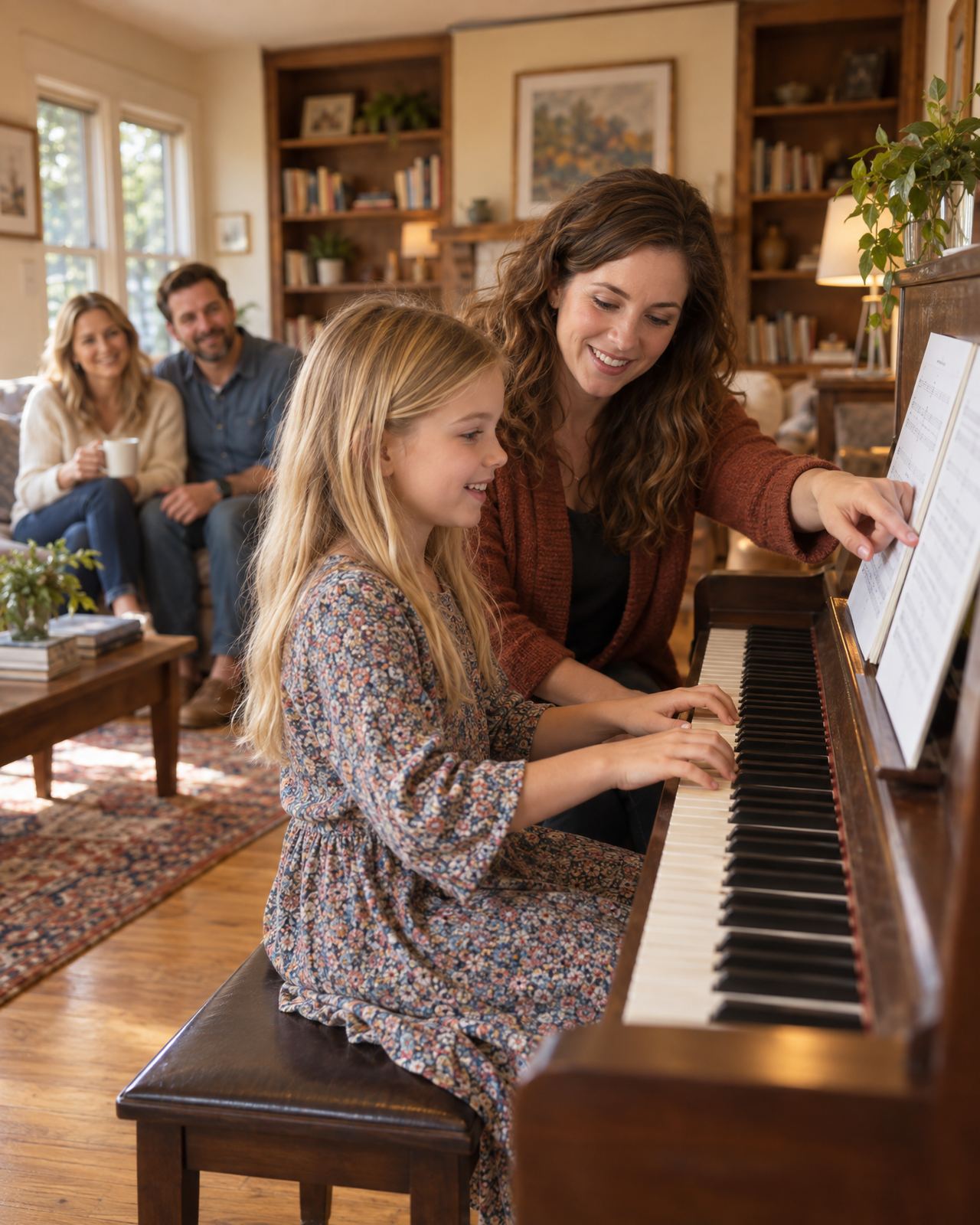
Short answer: for ages 4 to 6, start with piano, violin or ukulele. From about 6, guitar, drums and cello join the list, with voice lessons from about 7. Flute, viola and mandolin usually start around 8, and clarinet, saxophone, trumpet and bass around 9, with trombone around 10. At any age, the instrument your child is excited about usually beats the "right" one.
Ages 4 to 6: first notes
Best picks: piano, violin, ukulele.
Piano has no tuning or hand-size barrier, and it lays out every note in a row, which makes reading and theory easier for everything that comes later. Violins come in small fractional sizes that fit young arms, and many teachers start ear-first. Ukulele has four soft nylon strings and a small neck, and it's a natural path into guitar a year or two later.
Lessons at this age are short (30 minutes), playful and full of movement: rhythm games, finding notes, singing, first songs. Many children under 5 do better in group music classes until they can focus for about half an hour.
Ages 6 to 8: real skills
Add: guitar, drums, cello, and voice from about 7.
Most kids are ready for guitar around 6 or 7, when their hands can press the strings comfortably on the right-size guitar. Drums can start around 6 on a practice pad with sticks and hearing protection, building steady time before a full kit. Fractional cellos fit younger students. Voice lessons work from about 7 when they're built for a young voice: pitch, breathing and a light head voice, not heavy belting.
Ages 8 to 10: band and orchestra instruments
Add: flute, viola, mandolin (about 8), clarinet, saxophone, trumpet, bass and banjo (about 9), trombone (about 10).
Wind and brass instruments need air support, hand reach and, for many, adult front teeth, so they usually start a little later, often alongside school band. Trombone waits until arms can reach the slide positions. Bass suits kids whose hands can reach across the neck; a short-scale bass makes it easier. If your child is about to start band or orchestra at school, a few private lessons in that first year sort out embouchure, hand position or bow hold before habits set in.
Ages 10 to 12: their own music
Any instrument is open by now, and many kids move to 45-minute lessons. This is also when songwriting and music theory start to make sense, with music production from about 11 for kids comfortable on a computer.
Teens
Teens can start anything, and they often progress fast because they know the music they love and can practice with purpose. Many arrive with a goal: a band, an audition, a song. See lessons for teens.
How to choose between two
- Follow the excitement. A child who loves drums will practice drums more than piano they didn't choose.
- Think about your home. In an apartment or townhome, a digital piano, a violin, a ukulele or voice are easy; drums work with an electronic kit and headphones.
- Think about what's next. Planning on school band or orchestra? Starting that instrument early helps. No plan yet? Piano builds skills that carry into everything.
- Ask after one lesson. A teacher can tell you a lot about readiness and fit after meeting your child.
What you need at home
For most first instruments, less than you think: a digital piano with weighted keys, a right-size guitar or ukulele, sticks and a pad, or a rented violin. Talk to your teacher before buying anything big. For starting ages instrument by instrument, see the best age to start music lessons, and for lessons in your living room, in-home music lessons in Atlanta.
Common questions
My child wants drums. Should we start them on piano first?
Not necessarily. Piano is a great foundation, but a child who is excited about drums will usually practice more on drums. Start on a practice pad with sticks and hearing protection, and add a kit once practice is regular.
What if my child picks an instrument and wants to switch?
It happens, and it's rarely wasted time. Rhythm, reading and practice habits carry over. Talk to the teacher first, since sometimes the music or pace needs to change rather than the instrument.
Is ukulele a real instrument or a toy?
A real instrument. It's a full chord instrument with its own music, and its soft strings and small neck make it one of the friendliest first instruments for young kids. Many ukulele players move to guitar later with a head start.