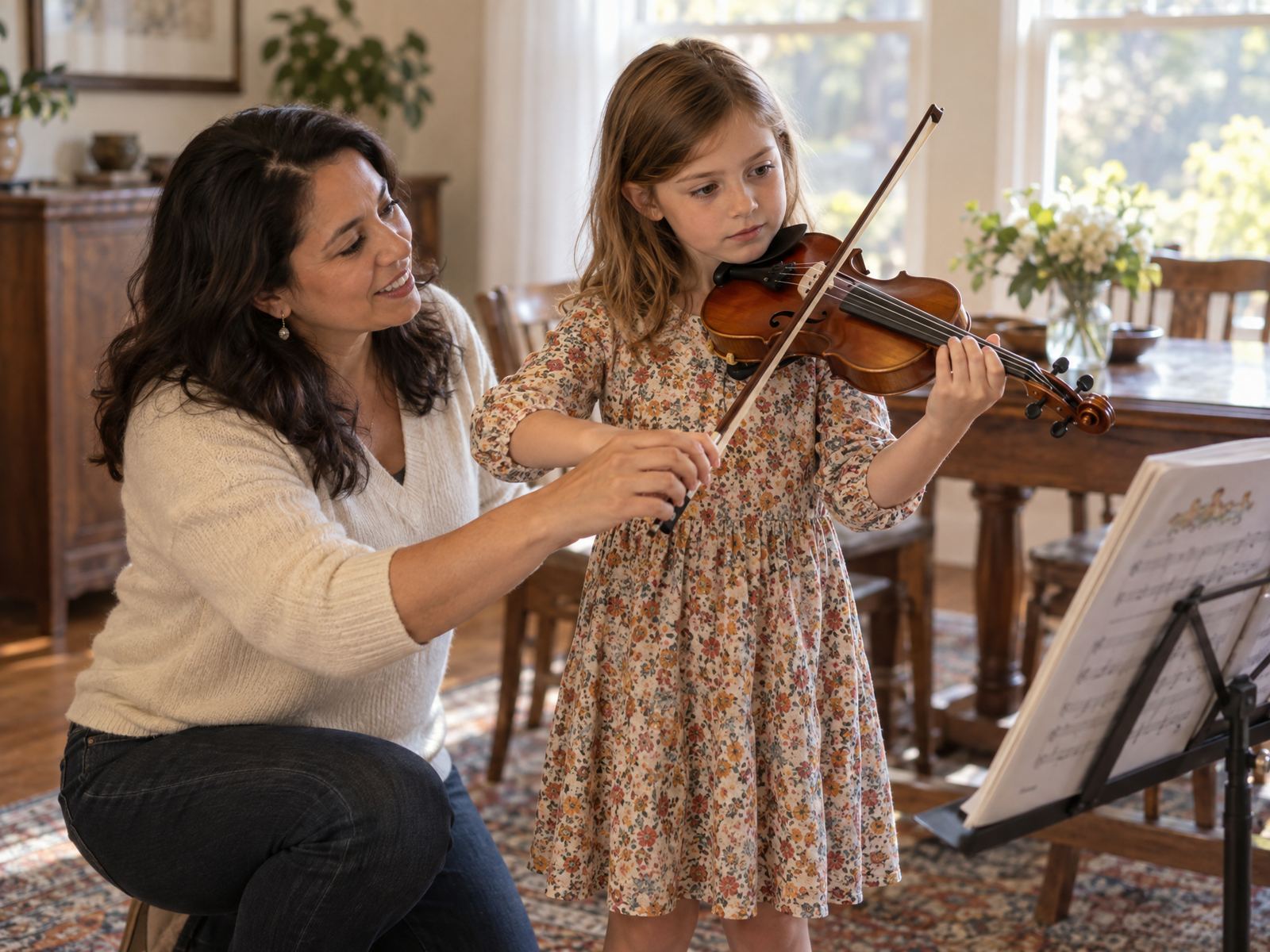
Short answer: beginners under 8 do well with 10 to 15 minutes most days; ages 8 to 12, about 15 to 30 minutes; teens, 30 minutes or more, with extra in the weeks before an audition. Five or six short sessions a week beat one long one, and what happens in those minutes matters more than the clock.
Practice time by age
| Age and level | Most days | Good to know |
|---|---|---|
| 4–7, beginner | 10–15 minutes | Two five-minute bursts count. Stop while it's still fun. |
| 8–12, first years | 15–30 minutes | A set time each day turns practice into a habit. |
| Teens, building up | 30–45 minutes | Split technique and songs; record yourself now and then. |
| Audition or advanced | 45 minutes or more | Plan backward from the date with your teacher. |
General guidance. Your teacher will set a plan for your child and adjust it as they grow.
Why short and often works
Learning an instrument is mostly building small physical habits: a hand shape, a bow stroke, a steady beat. Those stick through repetition spread across days, not one long push the night before a lesson. Short sessions also keep young kids from getting frustrated, which is what makes them want to come back tomorrow.
What a good practice session looks like
- Warm up (a few minutes): scales, a rhythm, a vocal warm-up, open strings.
- The hard part (most of the time): the one spot the practice plan points to, slowly, a few times in a row.
- Something fun (to finish): a song they love, start to finish.
Working on the hard part is what moves a student forward. Playing the easy song over and over feels good but doesn't.
How parents can help
- Same time, same place. After snack, before screens. Habits beat reminders.
- Keep the instrument out. A guitar on a stand gets played; a guitar in a case under the bed doesn't.
- Ask for a concert, not a timer. "Play me the new part" works better than "Did you do your 15 minutes?"
- Use the plan. At Stage Pass, your teacher sends a short practice plan after every lesson, so you know what to listen for without guessing.
- Praise the effort, especially on the hard part.
When practice turns into a fight
Talk to the teacher. Often the music needs to change, the goals are too big, or the practice plan doesn't fit a real school night. Songs your child actually likes fix a lot. If the fit with the teacher is the problem, a different teacher can turn it around. See how to choose a music teacher for your child.
Does lesson length change practice?
A little. Most children under 9 do best with 30-minute lessons, and older kids and those practicing regularly usually move to 45. Longer lessons leave more time for new material, so there's more to practice in between.
Ready to start? See music lessons for kids, in-home lessons in Atlanta, or pick an instrument: piano, guitar, violin, drums or voice.
Common questions
Should I make my child practice?
Gently, and with structure. Young kids need a routine and a parent nearby; they rarely practice on their own at first. A set time, a short plan and a little praise work better than pressure. As they get older and better, practice becomes more their own.
Is it OK to skip a day?
Yes. One or two days off a week is normal and healthy. What matters is that most days include a little practice, rather than none all week and an hour the night before the lesson.
Does practicing on a digital piano or electronic drum kit count?
Yes. The technique is the same. A digital piano with weighted keys and an electronic kit with mesh heads are great practice tools, especially in apartments and townhomes, and your teacher will help with the touch and dynamics that are easy to lose on them.